Immersion is now not only something game designers and developers are interested in, scientists are also studying its effects. Dr. Paul Cairns, a senior lecturer in Human Computer Interaction at York University is currently studying immersion, and how it relates to human traits of attentiveness, imagination and absorption. His research has found that people who have more absorptive personalities are able to become immersed in game worlds (Stuart, 2010). When someone is immersed it signifies that the person is interested in what is happening within the world or cares about the outcome of a certain events. Gamers are usually associated with being lazy, passive consumers of digital media when they are actually highly imaginative and emotional people, in order to extract the most out of a game.
Humans do not have an automatic switch so that they can behave differently depending on which world they are in -virtual or real-, for example in most MMO (massive multiplayer online) games when two players want to communicate they usually approach each other even though they are communicating through text, if 1 player is standing inside or too close to another the second player will typically step away as they feel it is an infringement of their personal space; even though it is virtual.
Spatial presence
Spatial presence is defined as existing when media contents are perceived as ‘real’ in the sense that media users experience a sensation of being spatially located in the mediated environment (Madigan, 2010). The idea is that any form of media creates a world, a space, where the person consuming that media is in that virtual space.
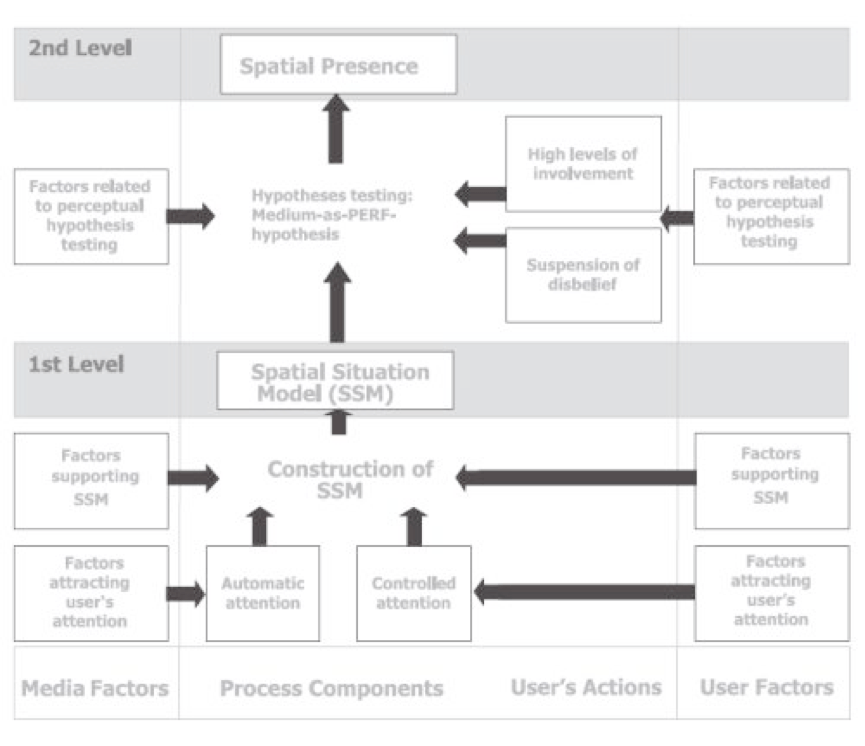
Initially the user is brought into the video game world by, progressing through the narrative, interacting with various characters, listening to certain sounds, etc. From there is when the user decides consciously or unconsciously whether the person feels as if he is in the game world or the real one.
In the article “The psychology of immersion in video games” the author talks about how games facilitate a users introduction into its spatial presence:
- Multiple channels of sensory information
- Completeness of sensory information
- Cognitively demanding environments
- A strong and interesting narrative, plot, or story
- Lack of incongruous visual cues in the game world
- Consistent behavior from things in the game world
- An unbroken presentation of the game world
- Interactivity with items in the game world
All of these points can be seen throughout different games that have a rich environment.
References
Gard, T. (2010 May 7th). Action adventure level design: Kung Fu zombie killer. Retrieved from http://www.gamasutra.com/view/feature/4413/action_adventure_level_design_.php
Madigan, J. (2010 July 27th). The psychology of immersion in video games. Retrieved from http://www.psychologyofgames.com/2010/07/the-psychology-of-immersion-in-video-games/
Stuart, K. (2010 August 11th). What do we mean when we call a game ‘immersive’?. Retrieved from http://www.theguardian.com/technology/gamesblog/2010/aug/10/games-science-of-immersion
 Filippo Santarelli
Leave a comment