Developing a game is a demanding job, but a lot more goes into just making a game. A lot of the work goes on before the work even begins. The scheduling and budgeting of a game rule out the scope of a project. By clearly defining the schedule and the budget a project has, it allows more focus to be placed solely on the development. Even when approaching a publisher or some entity to fund your game a detailed schedule along with a reasonable budget for the scope of the game is incredibly valuable for the developer and the investor, for different reasons, towards a common goal.
In the article “Budgeting and Scheduling Your Game” written by Luke Ahearn, who has over fourteen years of professional game development experience, explains the various steps and important information you should include in your schedule. Ahearn begins by saying that scheduling is not something that is done during development by just filling in the blanks, instead it is carefully written budgets, design documents, schedules, among other important documents (2001). The consequences from not providing proper planning or research in these documents will ultimately create a waste in time and effort because of problems with what the project encompasses is not made clear, the order in which the project will be developed is arbitrary, unable to understand how different parts of the game will work together, and if presented to financial backers errors, inconsistencies will be spotted. This creates a lot of uncertainty and the creation of new problems.
To begin with you must plan out your dream scenario, in doing so you will set the bar to its highest level where you will be able to make compromises later. In contrast with setting the bar lower, the design documents maximum potential will only be a standard product (Ahearn, 2001). Although this statement makes sense logically developers must also be reasonable in order to avoid planning a game in an extremely unlikely scenario. By having a physical version detailing as much about the project as possible, it will better streamline the workflow during the development. Through the creation of a multiple documents, like a game design document, a tech design doc and a schedule; the roles of the team members can be clearly defined, the resources that will be required, the tools that will be used and most importantly what is the expected end product from all these parts of the document. The article goes in depth into various ways in which the work can be divided and clearly understood by those reading the documents; through the use of Gantt charts, critical path method or the performance and evaluation review technique (Ahearn, 2001). Once all the scheduling and planning has been completed it is then time to create a budget. And a common pitfall that developers may fall into is finding a reasonable estimate. A balance is set between the budget and what they can produce. “An example being, hiring an inexperienced programmer for the job who may take longer to learn the tools and not work as fast, or hiring an overpowered, high priced, or even celebrity status programmer when he is not needed” (Ahearn, 2001).
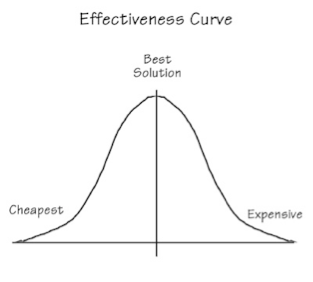
(Ahearn, 2001)
Through diligent research on the costs for all the resources and salaries coupled with the consideration of the deadline and the scope of the project. As well as the completion of any other design documents and schedules it will prove to be much more straightforward when approaching a publisher and developing the game since you will have something to refer to and guide yourself with.
References
Ahearn, Luke. (4 May 2001). http://www.gamasutra.com/view/feature/131492/budgeting_and_scheduling_your_game.php
Ahearn, Luke. [Untitled image of effectiveness curve]. (4 May 2001). Retrieved from http://www.gamasutra.com/view/feature/131492/budgeting_and_scheduling_your_game.php
 Filippo Santarelli
Leave a comment